Meteo Rwanda’s Meteorologists Enhance their Skills on Weather Radar Products.
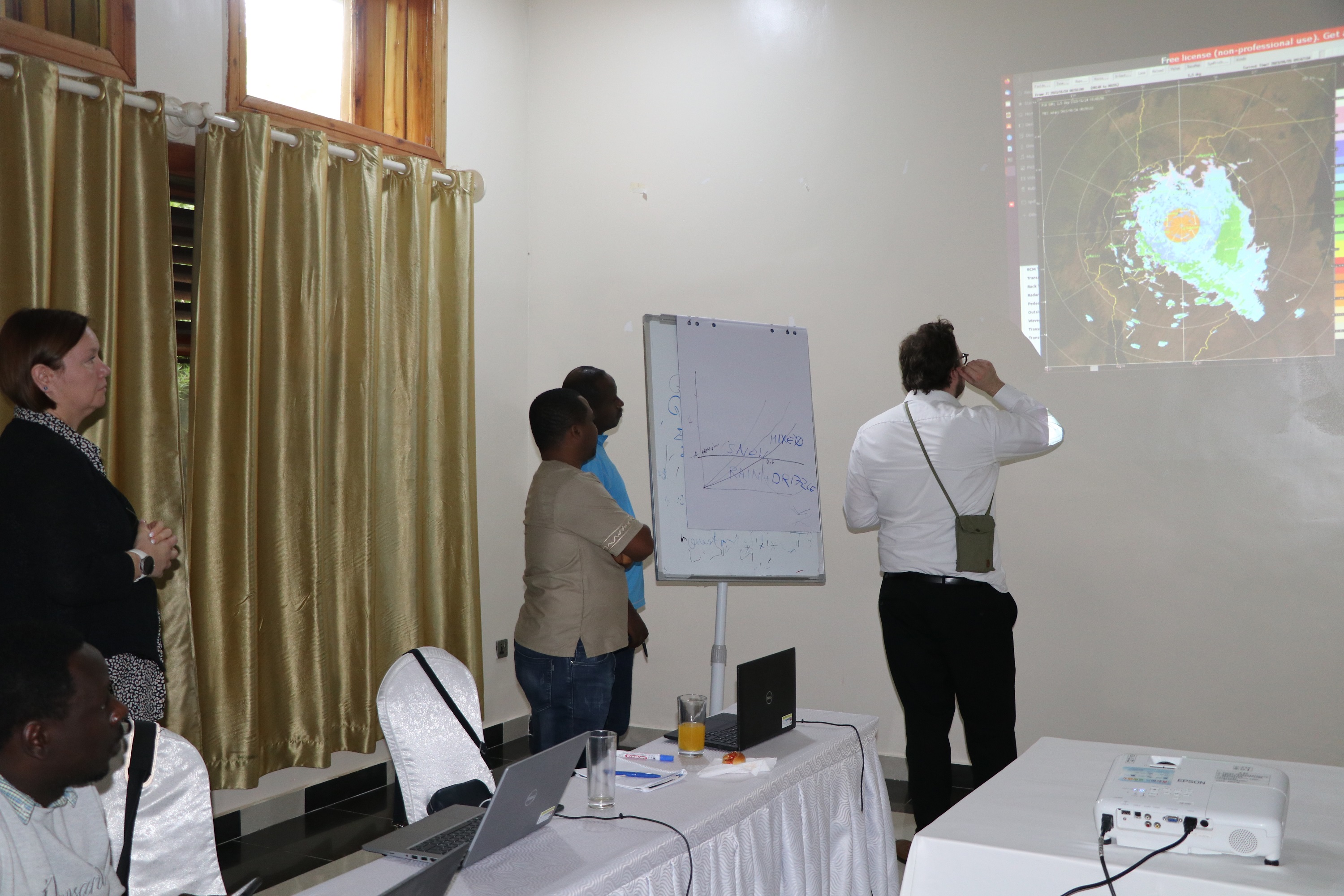
Rwanda Meteorology Agency (Meteo Rwanda) jointly with the Finnish Meteorological Institute (FMI) have concluded a weeklong training of Meteo Rwanda’s meteorologists with aim of enhancing their knowledge on weather radar products interpretation. The training was held from 23rd to 27th January 2023 in Musanze district, Northern Province and offered by Dr. Anne Hirsikko and Mr. Johannes Hakinnen both Experts at FMI.
This training was organized with support from Finnish Meteorological Institute - Kenya Meteorological Department -Rwanda Environmental Management Authority – Rwanda Meteorology Agency-Tanzania Meteorological Authority Project in abbreviation FINKERAT. The project was funded by the Ministry for Foreign Affairs of Finland through Finnish Meteorological Institute. It is part of activities that will be implemented under the program of improving the capacity of Meteo Rwanda to produce weather, climate and early warnings.
Topics covered during the training include among others: introduction to radars , processing, basics in Doppler Weather Radars products, types of Radar measurements, Radar based nowcasting and Radar products and operational applications.
The Director General of Meteo Rwanda, Mr. Aimable GAHIGI noted that meteorologists have to keep improving their knowledge to cope with the changing climate so that they can produce better services and products that meet users’ demands.
“Severe weather events are increasing fuelled by climate change. This requires our staff to keep learning new techniques to detect these extreme weather events on time and thus produce the weather and climate information that can help Rwandans to take appropriate decisions,” said Director General.
Mr. Aminadab Tuyisenge, Senior Forecaster and training participant said that the training will enhance their knowledge in analysing and interpreting radar products while producing now-casting forecast and other short ranges forecast.
What you need to know about Meteo Rwanda’s weather Radar
Meteo Rwanda’s weather Radar (ARC C250P) is installed on Maranyundo Hill in Bugesera district, Eastern Province. Weather Radar is critical for understanding the weather as it enables the user to see inside clouds and observe what is really happening there. Doppler Weather Radar (C Band) ARC C250P is capable of detecting particle type (rain, snow, hail, insects, etc), intensity, and motion. Radar data can be used to determine the structure of storms and to help with predicting severity of storms.
It has been implemented for studying precipitation variability and Quantitative Precipitation Estimation (QPE) for water resource management. It is an ideal operational system for monitoring severe and hazardous weather in real-time, as well as for post-event research and analysis of severe and hazardous weather and cloud and precipitation formation.
Weather Radar is the main tool used by Meteo Rwanda in producing nowcasting (0 to 6 hour forecast) and warning of rain, thunderstorms, hail and damaging winds.
About FINKERAT Project
The Finnish Meteorological Institute -Kenya Meteorological Department -Rwanda Environmental Management Authority – Rwanda Meteorology Agency-Tanzania Meteorological Authority Project aims to improve the capacity of the beneficiary countries, i.e. Kenya, Rwanda and Tanzania to adapt to climate change and to mitigate its impacts by strengthening the capacity of the designated institutions in the countries to provide and enhance the uptake of weather forecasting, early warning services and air quality services to communities, governmental institutions and economic sectors.
The project is expected benefit about 200 million East-African citizens from 2022 to 2025.
The FINKERAT Project will help Meteo Rwanda:
To improve capacity in the calibration of meteorological equipment;
To improve the capacity in the management and integration of meteorological observation data;
Training of staff to improve the capacity in the application of remote sensing information in weather and early warning services;
Training of staff to improve capacity in numerical weather predictions;
Modernization and improvement of the weather forecasting and early warning processes through deployment of modern systems (forecasting and early warning systems developed by FMI);
Automation of weather products generation and dissemination;
Customization of weather products for selected stakeholders;
Pilot forecasts and early warnings for vulnerable communities;
Observation network modernization plan development.
For more details about the FINKERAT Project, click here.